|
|
|
 |
Origins of the Universe—Does God Exist? A Philosophical Perspective
|
How Can We Know "Rationally" That God Exists?
If Something Exists Now, Then Something Must Exist Necessarily and Eternally! |
Index and Summary of this Page:
Introduction—The Great Debate: Evolution (Natural Selection) vs. Creationism (Intelligent Design)
Why is the Origin of the Universe Important?
Even though I desire to keep the focus of this website on Biblical Grace and Biblical Faith,
it would be an exercise in futility if the origins of the universe were merely random in nature instead of created by God, as recorded
in the book of Genesis. Therefore, if God does not exist, then all of the truth claims of Christianity found in the Biblical Scriptures
are nothing but man-made fiction and myths, including God's divine act of creating the universe, God's creation of man, man's
fall into sin, the forgiveness of sin, the redemption of man's soul, the virgin birth of Jesus Christ, the resurrection of Jesus Christ,
Heaven, Hell, miracles, eternal life, and so on. However, if God does exist, then all of these subjects are of the utmost importance
regarding the truth claims of Christianity. So, from a philosophical point of view, I will examine all of the possible Origins of
the Universe for understanding not only how the universe exists, but more importantly, why the universe exists!
Origin of the Universe—From God or Not From God?
In the last century, there has been much discussion and debate regarding the possible origin of the universe. The
real issue, however, is much deeper! The real core of the debate is predicated on the existence or non-existence of "God".
Evolutionists, with their presupposition that God does not exist, must account for the origins of the universe without any supernatural
assistance from an intelligent, transcendent being, such as God. Creationists, with their presupposition that God does exist, account
for the origins of the universe as a supernatural act of God's creation, where God is the sufficient "first cause" when accounting
for the origins and existence of the universe. So, how we account for the existence of the universe is directly proportional to our presuppositions
regarding the existence or non-existence of God.
The Fundamental Concepts of the "Lambda-CDM model" (The Big Bang) and "Evolution" (Natural Selection)
The "Lambda-CDM model": The standard secular model of cosmology, also called the "Lambda-CDM model",
is the simplest theoretical framework able to provide all the observed cosmological phenomena with just 6 free parameters. It promotes
the idea of Gradual Spontaneous Generation. In particular, the model predicts the existence and characteristics of the cosmic
microwave background, baryon acoustic oscillations, large-scale structures in the distribution of galaxies, the abundance of light elements,
and the accelerated expansion of the universe (due to the Lambda cosmological constant).
"Evolution": Non-intelligent, random change, with its mechanism of mutations based on a process referred to
as Natural Selection. This theory is primarily predicated on the idea that, given enough time and chance, favorable mutations,
through these mechanisms, are additive and result in higher and more complex forms of systems, beneficial to whatever is evolving.
Evolutionists promote the idea that all species of life can be traced back to a common ancestry
of simpler forms of biological systems that have gradually evolved to their current state over a time span of billions of years. Evolution
is faith in random, non-intelligent, naturalistic processes and mutations to account for the current state of the universe and
of life on earth. (God is not necessary) Evolutionists cannot, however, account for the existence or origins of the universe and usually
do not attempt to do so. They just accept that either the universe has always existed in some form or another, or that it just mysteriously
came into existence from some pre-existing materials that had always been present in the form of a singularity that, for some unknown
or uncaused reason, then exploded with a "big bang". But they still do not explain the origins of even the pre-existing matter,
other than it possibly being "self-created" from nothing for some unknown reason by chance through a process referred to by
Steven Hawking as "gradual spontaneous generation". (More on this later.)
The Fundamental Concept of "Creationism" (Intelligent Design)
"Creationism": Intelligent Design of the universe and purposeful and complete
systems on Earth, intelligently constructed for the purpose for which they were created and designed. Time and chance are not factors
in their existence. Random mutations, in the "Intelligent Design" model, are generally considered harmful and are the result
of entropy (a proven scientific principle of deterioration) of these systems that make them less useful or even permanently useless over
time.
Creationists promote the idea that all major species of life on earth were created separately (each after its own kind) and
are relatively young in age. Creationism is faith in intelligent, creative processes to account for the existence of the universe
and life on earth. (God is necessary) Creationists account for the existence of the universe by the purposeful act of special creation
from an intelligent source transcendent to the universe itself.
Furthermore, since "Creationism" has its basis and premise in "A Creator", this Creator (referred to as God)
has a purpose in His creation and for His creation. A sovereign choice was made to create ex nihilo, from no pre-existing matter.
His choice to create was not random or accidental but rather purposeful and deliberate for a specific reason. Therefore, a relationship
exists between the Creator and that which He has created.
The Fundamental Concept of "Theistic Evolution" (A Combination of Creationism and Evolution)
"Theistic Evolution": Some acknowledge God as the first cause of the universe, but also
maintain that God then set in motion the macro-evolutionary processes that did the rest under its own impetus. In other words, it is
argued that God created the self-generating process of evolution and let everything evolve through time and chance by means of natural
selection. Hard-core evolutionists reject the idea of Theistic Evolution because they reject the very existence of God. Hard-core
creationists reject the idea of Theistic Evolution because they see a gross injustice done to the Biblical Genesis account of
creation that is destructive to the idea of a literal Garden of Eden, a literal rebellion, the existence of sin, real redemption, and
anything else in Genesis that is central to established Christian doctrine.
Theistic Evolutionists, on the other hand, attempt to combine creation with evolution, thinking that they can preserve their religious
or theistic view of God, while observing scientific rationale for evolution at the same time. The problem with trying to combine these
two systems is similar to trying to combine water and oil. Evolution and creation cannot mix rationally because of too many self-contradictory
assumptions between the two. One views the Genesis account as being just symbolic and metaphorical in nature, and the other as being
quite literal. The fall of Adam (and of mankind) in the Garden of Eden was either a fictional story or it actually happened. The Biblical
record of human lineage from Adam to Jesus Christ was either a fictional story or it actually happened. And so on.
The only source we have, regarding God's creation of the universe, is the Biblical account of Genesis and references to the book of Genesis
in other Biblical Scriptures. If the Biblical account of creation is literal and correct, then Adam and Eve were real people that God
created who fell into sin, and their descendants, through the meticulous lineage given (Adam to Noah to Moses to David to Jesus) were
real. So if Christ was real (the Cornerstone of Christianity, through which redemption of humanity comes), then Moses was real, Noah
was real, and Adam was real, resulting in human existence and history that spans only about 6,000 years. But according to evolution theory,
man has evolved from the primordial soup dating back millions of years. If Adam and Eve were just fictitious characters, not meant to
be taken as literal people, then obviously, their descendants were fictitious, all the way to Jesus of Nazareth. Therefore, if Adam is
a hoax, then sin is a hoax, salvation is a hoax, and Jesus is a hoax, thereby undermining everything the Bible teaches about redemption
and salvation.
If one embraces theistic evolution or macro evolution, even in part, then they must reject the 7-day Biblical creation account given
in the book of Genesis as being literal and therefore reject everything that Genesis teaches about the literal fall of Adam and Eve into
sin, because it would all be an illusion. If the creation account in Genesis is true, then theistic and macro evolution must be rejected
as any valid theology or science. Both creation and evolution cannot be true at the same time and in the same relationship because they
are contradictory to each other. One is based on the existence of God, and the other is based on the non-existence of God. One is true,
and the other is not.
Science vs. Faith
Someone may point out that it is science that has persuaded them to believe or not believe in the existence of
God. However, this really makes no sense since science can never prove the existence or non-existence of God in the first place. Science
is an extremely useful tool that can be credited with much of what we have discovered and understand about the material universe, but
falls short in scope of proving or disproving spiritual matters transcendent to the observable material universe.
Often, we hear the argument that Evolutionism has its basis in science and that Creationism has its basis in faith.
While both are true in part, this is only half of the picture. The theory of Evolution has as much basis in faith as does Creationism,
and Creationism has as much basis in science as does Evolution! Both systems have plenty of science (some good, some
bad) to justify their acceptance. Likewise, both systems require that a certain amount of faith be employed for their acceptance. The
problem here is not with either science or faith, but with presuppositions and bias already held by the one doing the investigations.
Presuppositions and bias can be major obstacles in the pursuit of truth and can often lead to false conclusions. When someone proclaims
that the Theory of Evolution is scientific, what they really mean is that they have faith that God does not exist, they have
faith that the universe is billions of years old, and they have faith that all of the many evolutionary presuppositions held are true,
without being able to prove anything with a truly scientific methodology. If God is the source of the universe, you can imagine the impossible
task that secular science would have trying to explain and account for the universe scientifically. While true, testable, and reproducible
science can be a great tool in helping our understanding of the nature and cause of certain things, scientific methods are simply not
sufficient for examining spiritual matters because supernatural events are scientifically unfalsifiable, if indeed spiritual forces are
at work here.
Same Evidence, Different Presuppositions
Regarding evolution vs. creation, there seems to be physical evidence that, when interpreted one way or the other, supports one theory
or the other, but not both at the same time. These systems are mutually exclusive because one system depends on the non-existence of
God and the other depends on the existence of God. Both cannot be true at the same time and in the same relationship. Both camps use
the same observable evidence in developing their arguments and theories, but from different presuppositions. Physical evidence, then,
becomes very subjective and based on one's preconceived view of the existence or non-existence of God. A good example of this is assumptions
regarding light speed and time constants. In today's observable universe, we understand that light travels about 186,282 miles per second
in the vacuum of space. What we don't know is if light has always behaved this way in the past. Is it possible that light perhaps traveled
slower or even faster in the past? If you are an evolutionist, you may be tempted to say slower. If you are a creationist, you may be
tempted to say faster. Both evolution and creation science have a problem accounting for time vs. distance in their respective models
in the current observable universe. If you are a creationist, the universe appears to look older than it should. If you are an evolutionist,
the universe appears to look younger than it should.
The "Starlight-Distance-Time Problem" with Creation Science
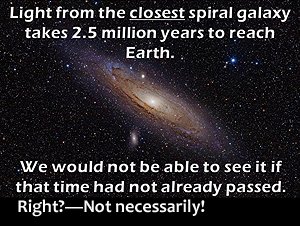
How can starlight from distant galaxies, billions of light-years away, be seen in a universe that's only about
6,000 years old? (A Light-Travel-Time Problem)
If distant starlight is indeed billions of light-years away, how is it that we can see this light in a young universe? This is a great
question and an honest one! However, there are a few scientific assumptions being made by accepting the consensus on how long it would
take distant starlight to reach us. One must assume at least one of the following: light speed has always been constant, time passage
has always been constant, there has been no supernatural influence on the origins or mechanisms of the universe, and that the nature
of light travel time throughout the universe is fully understood. If any one of these assumptions is inaccurate, then subsequent
conclusions will be suspect or misleading.
Possible explanations for the "Starlight-Distance-Time" problem have been: (1) Because of early gravitational forces present
in the beginning, light may have traveled much faster in the past, (2) Time may NOT be fluid and may have had a different rate of passage
in the past (i.e. Time Dilation), (3) God would not be bound to current observable laws of physics which was created by Him,
so perhaps God's creation of the universe employed temporary conditions or laws which were different then as compared to His conditions
for maintenance of the universe in its present form and (4), The most current solution, "The
Anisotropic Synchrony Convention (ASC)"; a complex model that suggests the speed of incoming light from the universe as being
virtually instantaneous as opposed to the speed of light leaving us. If that were the case, God could have created the universe in such
a way that man could view and enjoy the starlight of His created universe immediately and in real-time currently.
When we dig into the details of the Starlight-Distance-Time issue, we find that it does NOT prove that the universe must be
old. For more on these possible explanations, please visit the following links:
"The Anisotropic
Synchrony Convention (ASC)—A Solution to the Distant Starlight Problem—strophysicist Dr. Jason Lisle"
"Does Distant Starlight Prove the Universe
Is Old?—Astrophysicist Dr. Jason Lisle"
"Evidence for a Young Universe—Astrophysicist Dr.
Jason Lisle"
"Six
Evidences of a Young Earth—Answers in Genesis"
The "Horizon Problem" with Lambda-CDM Science
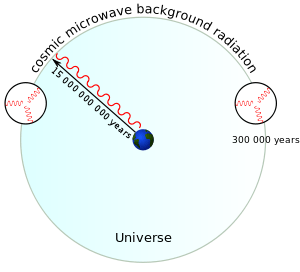
How can the random "Cosmic Microwave Background" radiation (CMB) be at equal temperatures
from one side of the visible universe to the other side of the visible universe in only about 13.8 billion years, when it should have
taken much, much longer for this to be possible at the speed of light? (A Light-Travel-Time Problem)
According to modern science acknowledged by most scientists, the measured temperature of the Cosmic Microwave Background radiation
(CMB) is essentially the same everywhere—in all directions (to a precision of 1 part in 100,000). However, according to Big Bang
theorists, in the early universe, the temperature of the CMB would have been very different at different places in space due to the random
nature of the initial conditions. These different regions could come to the same temperature if they were in close contact. More distant
regions would come to equilibrium by exchanging radiation (i.e., light). The radiation would carry energy from warmer regions to cooler
ones until they had the same temperature.
The problem is this: Even assuming the Big Bang timescale, there has not been enough time for light to travel between widely separated
regions of space. So how can the different regions of the current CMB have such precisely uniform temperatures if they have never communicated
with each other? This is a light-travel–time problem!
The Big Bang model assumes that the universe is many billions of years old. While this timescale is sufficient for light to travel from
distant galaxies to Earth, it does not provide enough time for light to travel from one side of the visible universe to the other. At
the time the light was emitted (supposedly 300,000 years after the Big Bang), space already had a uniform temperature over a range at
least ten times larger than the distance that light could have traveled (called the "horizon"). So, how can these
regions look the same, i.e., have the same temperature? How can one side of the visible universe "know" about the other side
if there has not been enough time for the information to be exchanged? This is referred to as the "Horizon Problem".
Secular astronomers have proposed many possible solutions to this problem, but no satisfactory one has emerged to date.
Some evolutionists have even suggested time-dilation or light-speed differences in the past to account for their Horizon problem.
It's interesting to note that when creationists suggest these solutions for their Starlight-Distance problem, it is regarded
as a desperate attempt to reconcile their view of a young universe and is considered as improvable and unacceptable science. But when
these same solutions are applied to evolution's Horizon problem, it is regarded as good science in reconciling their view of
a very old universe. So, both creationists and evolutionists have Light-Travel-Time problems to deal with. In essence, creationists
have the task of demonstrating that the universe is younger than it appears, and evolutionists have the task of demonstrating that the
universe is older than it appears. The problem is that there is no way to demonstrate or replicate conditions or variables that may have
been different in the past with current conditions or variables. In other words, it is beyond the scope and possibilities for science
to test, replicate, and prove evolution or creation processes in a science lab because evolution would take too much time in its randomness
(13.8 billion years?) and creation was an exclusive event performed supernaturally by God just once, not likely to be repeated by mere
mortals. So where do we go from here?
Philosophy Can Help When Science Cannot
Since evolution or creation processes cannot be reproduced in a science lab, pure testable and reproducible science
cannot confirm or debunk either system, nor can it prove or disprove the existence of God. All scientific theories must be falsifiable,
in principle, using new evidence. If a theory cannot be falsified, it is not a valid scientific theory. This is where philosophy can
step in and help. Taking a philosophical approach, we can test, rationally, for the existence or non-existence of God. I am not trying
to reduce God to some mere philosophical construct nor minimize anyone's faith in His existence; rather, I believe that demonstrating
rationally that God exists will further support our faith in Him, not destroy it. The Apostle Paul encouraged us to "reason together".
Since the existence or non-existence of God is at the central core of the creation/evolution debate regarding origins, it is important
that we know rationally if God exists or not. If we can prove this rationally either way, we have taken a huge step in how to properly
interpret the observable evidence of the universe in accounting for its origins, and just as importantly, for its very existence at all!
 Back
to Top Back
to Top
Accounting for Reality As We Experience It
An Initial Presupposition To Deal With
Before accounting for the existence of the universe, we are already guilty of presupposing that the universe does
indeed exist as a reality. So, to not assume anything here or leave any stone unturned philosophically, we must first consider the idea
that perhaps nothing exists and that any reality that we think we are experiencing, including the existence of the universe, is nothing
more than just an illusion. First of all, if we doubt that anything exists at all, we would have at least one thing that would exist
to account for, and that is our doubt itself. And even if we doubt our doubt, we still have a doubt to deal with. So at least doubt exists.
The very act of doubting is an act of conscious thinking. And the act of thinking can only be possible by something existent. To doubt
is to think, and to think is to be.
René Descartes, a famous 17th-century French mathematician and philosopher, coined this famous motto: "Cogito Ergo Sum",
translated "I Think, Therefore I Am". After decades of philosophical inquiry and skepticism, he determined that his knowledge
of his own self-consciousness was trustworthy in concluding that indeed, at least something exists, even if it is nothing more than his
own consciousness and experience!
Another way to approach this is to ask this question: If nothing exists and everything is just an illusion, who is having the illusion?
At least the illusion exists; therefore, something exists, even if it is just an illusion. Someone may argue that even the illusion of
something is just an illusion. We could keep going with this circular logic until infinite regress occurs, but we would still be left
with an illusion to account for, no matter how many levels of illusion we consider! Therefore, we cannot presume that absolutely nothing
exists since even an illusion itself is something that exists!
The interesting and obvious philosophical elephant in the room here, with all of these questions, is the nature and origin of the questions
themselves. If nothing existed at all, who or what is asking the questions? To question is to think, and to think is an obvious indication
of consciousness at work. Nothingness can not ask questions. So even questioning anything proves the existence of consciousness of some
kind!
In conclusion, declaring that nothing exists and that everything is just an illusion violates the philosophical law of non-contradiction.
If nothing exists, then an illusion would not exist either! If an illusion exists, then something exists, even if it is just an illusion!
Nothing existing and an illusion existing at the same time and in the same relationship is a nonsense statement. So if we are making
contact with reality at all here and can trust rationally that something does indeed exist, we can move on, discounting any notion that
nothing exists and continuing our quest to account for what does exist.
Back
to Top
Accounting for the Existence of the Universe
There are three and only three possible scenarios to consider when accounting for the existence of the universe:
-
The universe was self-created (Ex Nihilo—It
created itself from nothing)
-
The universe is self-existent (Eternal—It
has always existed in some form or another)
-
The universe is the result of something or someone
self-existent (Created by something eternal)
These three scenarios cover EVERY possible theory and explanation when accounting for the existence
of the universe. Let's examine each one.
(1) The Universe Was Self-Created (Ex Nihilo—From Nothing)?
A Critical and Important Question:
If there were ever a time when absolutely nothing existed, what would exist now?
It's almost impossible to even imagine a time when absolutely nothing existed; no space, no gravity, no mass, no
molecules, no light, no dust, no dark matter, not a hint of anything—absolutely nothing! So if there were ever a time when absolutely
nothing existed, what would possibly exist now? Absolutely nothing! How can we know this rationally?
Ex Nihilo Nihil Fit—(From Nothing, Nothing Comes)
In order for something to exist now without anything existing in the past, at some point in time, something would
have been required to create itself. Is this even possible? Rationally, we can be confident that nothing can be self-created because
of a fundamental and inescapable law of reason: "Ex Nihilo Nihil Fit"—"From Nothing, Nothing Comes". This reasoning
conforms to the law of non-contradiction and MUST be true, or reason itself means nothing! If it were possible for something to
come from nothing (self-created), it would have to be before it is. In other words, it would have to be, and not be,
at the same time and in the same relationship. This is absurd reasoning and violates the Law of Non-Contradiction! Nothing can
"be" and "not be" at the same time and in the same relationship. Nothing!! Additionally, self-creation
also violates the Law of Causality as it would require an effect without a cause, which is also based on absurd reasoning. These
are very important and necessary laws of logic to observe for any hope of rational conclusions based on reality. (See
my "Philosophy" page for more on this.)
Therefore, if something exists now, then something exists necessarily and eternally. In other words, if something exists now, then something
HAD to always exist—necessarily! There could NEVER have been a time when absolutely nothing existed because if there were
such a time, then nothing would or should exist now! Therefore, since something does exist now, then something has had to always exist
out of necessity! Its existence would have to be eternal without beginning or end. It would have the necessary power of being within itself
to have always existed. Whatever it is out there that is eternal, it cannot, not be! From a rational point of view, it must exist
necessarily!
I'm certain that at some point, some newfangled ideas or theories, masquerading themselves as valid science, will argue that indeed something
could have come from nothing. How they will argue this will probably be through some creative expression of quantum physics and/or complex
mathematics, or who knows what. But all of the quantum physics and mathematical speculation in the world cannot overcome the problem of
the existence or the non-existence of something. Something either exists or does not exist, but not both or neither at the same time. Philosophically
speaking, we just cannot have it both ways and be expected to make any rational sense of it! Nothing can create itself. If anything exists,
then something exists necessarily!
Did the Universe Create Itself?—Can ANYTHING Create Itself?
We already looked into the irrational idea of Self-Creation, but it is worth drilling into a bit further,
just for the sake of clarity and thoroughness in the matter. (No pun intended) The idea behind the theory of a self-created universe
is the assumption that at some point in time past, absolutely nothing existed, and then in an instant, or in some measure of time, the
universe, or at least the building materials necessary for the universe, suddenly and mysteriously appeared from nowhere and from nothingness
through a process referred to as "spontaneous generation". Can anything accomplish a feat of this magnitude? Remember that for
something to create itself, it must be, and not be, at the same time and in the same relationship. It would be called on to bring itself
into existence before it is. How is this possible? By sheer reason, it is not possible! Again, for something to create itself, it must
be and not be at the same time and in the same relationship, which is a gross and preposterous contradiction of all things
regarding a reasonable and rational explanation. Nothing can create itself! To argue for a self-created universe is to argue that
it had to exist and not exist at the same time and in the same relationship. One must violate both the law of non-contradiction
and the law of causality in their reasoning, or in this case, their lack of reasoning, by declaring that the universe existed
before it existed, or that the universe was caused with no cause, to be self-created. This does not seem like a compelling argument
that has any basis in reason or rationality, but rather an argument that completely dismisses logic as any valid methodology in determining
a rational truth of reality. Ex Nihilo Nihil Fit (From Nothing, Nothing Comes) is not some deeply profound philosophical
jargon—It is simple logic and quite frankly, just common sense!
Can Time and Chance Play a Role in any Self-Creation?
Some argue that given enough Time and Chance, anything can happen, even self-creation.
In centuries past, some scientists held to a self-creation view referred to as "spontaneous generation" to account for
the existence of life from non-life. Even though this theory has long been abandoned, in recent scientific history, a modified version
of the term called "gradual spontaneous generation", coined by the famous Steven Hawking, has been used, suggesting
that a slow and "gradual" time frame could make this "spontaneous" event more scientifically acceptable with time added.
In other words, you can't get something from nothing quickly—you must wait for it! Aside from gradual spontaneousness
being self-contradictory as any temporal possibility, I would like to briefly explore this idea because I think it is important
to understand just what influence time and/or chance might have on anything.
-
What is Time?
Time is a word. Time is ONLY a word used to express an abstract idea of motion in the passage of events that make up our lives. Time,
regardless of what science fiction writers would have us believe, is NOT another dimension in which we can travel freely, other than
in the natural flow of time passage itself. There are only three dimensions in the physical, cosmological world: height, width and
depth. We live in a three-dimensional world. These three dimensions are observable and are necessary for anything to exist in the physical
universe. To define any other dimension, beyond the three (in the physical world), would be metaphysical in nature and outside of any
observable or acceptable concrete science, even though it makes for some great science fiction. If a "4th dimension" were
to be defined, it would have to be referring to the transcendent spiritual realm and outside the constraints of the material, physical
universe and its properties, as well as outside of the constraints of time. In the spiritual realm, time would have no relevance or
reference regarding its subjects. In any case, time is "No Thing"... Time is "Nothing". It has no power,
because it has no being or real existence outside of an abstract idea. It is only a word and nothing more! Ironically, if Einstein's
Special Theory of Relativity is true hypothetically, it could be argued that the seemingly billions of years that have passed
in our space-time continuum (from our perspective) may have only been a mere few thousand years of relative time from the
perspective of the universe. However, this does not change the fundamental point here—given six thousand years or six billion,
something cannot come from nothing, or be before it is. All the time in the universe is still not sufficient for
the self-creation of the universe.
-
What is Chance?
Chance is just another word that we use to describe mathematical probabilities based on relative factors. If a coin is flipped, it
is commonly understood that the chance or odds of that coin turning up tails, for example, will be 50 percent.
But does chance itself influence this result? No. What influences the result are variables that are real and that can be quantifiably
accounted for and measured, such as weight, air density, pressure exerted on the coin when flipped, which side we started with, how
we catch it, whether we turn it over after being caught, etc. There are several variables that will determine the coin's final side
of exposure. But chance itself does not have any power or influence in determining the results, because chance has no being,
thus no power to do so. Chance is "No Thing"... Chance is "Nothing". At least with a coin, we have something existent
to work with. But if nothing existed, of what value would "Chance" be on influencing nothingness, even if it could influence
anything already in existence? And remember, if there is nothingness, then even chance itself wouldn't exist either!
Interestingly, chance is the most frequently used explanation for a self-created universe. But its nemesis is self-contradiction!
The chances of a self-created universe from nothingness are zero simply because chance cannot exist in nothingness, and nothing can
create itself from nothingness.
Nothing + Time + Chance = Nothing Because Nothing Plus Nothing Plus Nothing Still Equals Nothing!
Starting with nothing, and given enough time (Nothing) plus enough chance (Nothing) will still
result in NOTHING! Time and chance cannot be motivators for a self-created universe, because neither time nor chance has any being
or power to motivate anything. And if time and chance had being and power, then we would not be starting with nothing,
since anything with "being" is something.
Some may try to point out that the Christian view of the universe, which maintains that God created the universe Ex Nihilo (from
nothing) is guilty of the same claim as the cosmological view of the universe, stating that the universe was created Ex Nihilo
(out of nothing). The Creationist / Intelligent Design view never claims that the universe came from absolutely nothing
because the view maintains that God is something and has always existed with sufficiency to create the universe from no other
existing matter.
Surely, No One Really Believes that the Universe Actually Created Itself, Do They?
Evolutionists don't like to talk about origins very often because they cannot explain events and/or circumstances
prior to their Big Bang, even in theory. However, some evolutionists proclaim that nothing existed before the Big Bang
(which, hopefully, I have successfully argued against). These evolutionists have the impossible task of proving that nothing existed at
some point in time in an attempt to prove that at least God doesn't exist. Ironically, by holding to a self-creation view of the
universe, they have also unwittingly left themselves open to the idea of a self-created god! Therefore, a self-created view of
the universe does not bring any relief for those who are really trying to rule out the existence of God. If indeed ANYTHING could create
itself, then ANYTHING could potentially exist, including some god!
The mantra and gods of evolution are time, chance, and natural selection (as if anything in nature, without
intelligence, can make intelligent choices in "selecting" anything at all). In other words, their faith (belief
system) is predicated on randomness rather than on order. It is the belief that disorder and non-complexity can and do evolve
into order and complexity, given enough time and chance, through helpful mutations, that somehow know or can discern what is helpful to
the system evolving. But a value judgment involving "what is helpful" would require intelligence or intelligent design, which
they avoid at all costs, because this would suggest intelligence transcendent to the universe for which they would have to account for
and be accountable to.
There is no true, hard science involved in any "macro-evolutionary" process (microbe-to-man) because it is
not testable, provable, reproducible, or falsifiable. It is a belief system, based on faith, that everything we have is the result of nothing
for no apparent reason. Evolutionists would be quick to argue that the "goal" of evolution is to improve itself, but
without any implied or necessary intelligence.
Note: It is important to distinguish the differences between Micro-Evolution and Macro-Evolution systems.
The mainstream evolutionist will argue for the "Macro-Evolutionary" model, which promotes the belief that man has
evolved from lower forms of life (the ape) and that all species of life are the result of progressively lower species, all the way back
to microbes and back to the "primordial soup" that everything owes its existence.
The creationist recognizes that there is justifiable evidence to support a "Micro-Evolutionary" process that involves
change and mutations within a given species, as an adaptation to environmental conditions, but NOT a process that causes one species to
evolve into another.
The Universe Could Not Have Created Itself Because Nothing Can Create Itself!
To summarize, the universe could not have created itself because nothing can create itself! For "self-creation" to be a possibility
at all, it would be required to exist before it is, or exist and not exist at the same time and in the same relationship. Philosophically
and even metaphysically, this is impossible and not a rational option to consider when accounting for the existence of the universe.
Back
to Top
(2) The Universe is Self-Existent (Eternal)?
Has the Universe Always Existed?
Although there are atheistic scientists who believe that the universe existed in some form or another before a Big
Bang, it must be known that they present no evidence for this belief, since none exists. This kind of belief is metaphysical in nature.
Appeals to multiple or "parallel" cosmoses or to an infinite number of cosmic "Big Bang—Crunch" oscillations,
as essential elements of the proposed mechanisms, are not acceptable in submissions, due to a lack of empirical correlation and testability.
Such beliefs are without hard physical evidence and must therefore be considered unfalsifiable, currently outside the methodology of scientific
investigation to confirm or disprove, and therefore more mathematically theoretical and metaphysical than scientific in nature or provable
with any known science. The laws of physics simply do not support such claims. Recent cosmological evidence also suggests insufficient
mass for gravity to reverse continuing cosmic expansion. The best cosmological evidence thus far suggests that the cosmos is finite rather
than infinite in age.
Also, evolutionists who subscribe to the eternal universe model must proclaim that the necessary materials or building blocks
(or something even before these) have existed forever, perhaps in some altered state of existence referred to by some as a "point
of singularity". But as to why or how this pre-Big Bang point of singularity or material suddenly materialized into
the current universe is a subject matter that they will avoid at all costs because this forces them to deal with causality. (More
on this below) This is the hallmark position of an atheist because they have no other possible choice available to them in their belief
(faith) system, other than believing that the universe has always existed in some form or another, before the Big Bang.
Philosophically, if the universe has always existed, then by reason and by definition, there could not, and should not be any change involved
with the universe. Change requires influence. And if something is defined as eternal, then self-change cannot be an attribute,
or it would not, by definition, be eternal at all. However, the material universe has, and indeed still is, undergoing continual
and drastic change. It is not the same yesterday, today, and tomorrow. The universe is mutable, changeable, and in constant flux. Therefore,
the material universe cannot be self existent and eternal for these reasons. Change can only be accounted for by an external or transcendent
influence for any change to be possible at all. The ultimate explanation of the existence of all things, therefore, must be the existence
of some necessary Being as the transcendent source of influence and change. This necessary being is readily identified by proponents of
the "cosmological argument" as God. This involves a philosophical and cosmological argument from contingency,
which can be summarized as follows:
(1) Everything that exists contingently has a reason for its existence.
(2) The universe exists contingently, therefore
(3) The universe has a reason for its existence, therefore
(4) That reason is God, therefore
(5) God exists.
One may argue that even though the universe is changing, the original components, atoms, particles, etc., may have always existed without
any necessary being, such as God. But even if these so-called "eternal particles" are eternal, then even their order and configuration
should not have ever changed. Again, change requires outside influence (the philosophical law
of causality as well as an argument from contingency), whether it has influenced the universe as a whole, or at least
in some sub-matrix component of the universe not yet known about. In other words, if the universe always existed before any Big Bang or
singularity in some space/time existence for eternity past, then it should be the same now and the same in an eternal future.
The obvious problem here is that the universe has apparently changed for some reason at some point in time! No matter how we break it down,
the universe is changing, and we must look to a necessary, transcendent source outside of the universe for the motivation and causality
of its ever-changing condition. Since that which is necessarily eternal cannot exhibit change on itself (otherwise it is not eternal) and
since the universe is undergoing extreme change, then we must look beyond the universe itself to an eternal force or being that transcends
and is responsible for the changing universe, because something is necessarily eternal, and it is not the universe!
Back
to Top
(3) The Universe is the Result of Something or Someone Self-Existent (Created)
The Universe Was Created!
The only option left in our philosophical process of deductive reasoning is the reality that something or someone
self-existent, eternal and transcendent to the universe, is directly responsible for the existence of our ever-changing
finite mutable universe. Something with the power of being in and of itself, with the necessary power and self-existence, eternal and unchangeable,
is at the very core of all things that exist. All things that exist have their origins from this source.
We could stop right here, proclaiming that we have gone as far as we need to go with a compelling argument for the existence of something
eternal and transcendent to the universe. Philosophically, there is compelling evidence that something has always existed before the existence
of the universe. But for the sake of argument, and to push on a little further, let's examine the rationale for this eternal source being
intelligent rather than just being eternally non-intelligent.
Is the Eternal Source, Transcendent to the Universe, Just Inanimate in Nature?
An inanimate, lifeless, and impersonal source, if eternal, would eternally be incapable of creating, because the
act of creating, or producing something on its own, outside of itself, would require the power of choice, which requires intelligence and
therefore purpose. By definition, anything inanimate is without life or intelligence. Without life and without intelligence, there is no
independence of choice, reason, purpose, or anything else creative enough to "choose" to influence anything nonexistent outside
of itself, into something existent outside of itself. And by reason, if something inanimate is the eternal source we are looking for, that
which has always existed before the universe should be all that would still exist now and nothing more, including the universe.
Does "Intelligent Design" Prove the Existence of "God"?—Philosophically, it Should!
Intelligent design requires an intelligent designer. However, some would argue that the existence of an intelligent
designer does not necessarily prove the existence of "God". In fact, there are creation scientists who are not even
comfortable with the term Intelligent Design, claiming that they do not want to be identified with the Intelligent Design
group that accepts the existence of God. Some Intelligent Design advocates still deny the existence of God, declaring
that the intelligence they are referring to is a non-personal, amoral agent with no righteous requirements or expectations of its designed
creation. If this were the case, philosophically, it would make one wonder why any of us would have any sense of morality or righteousness
at all. Where does that come from? What distinguishes right from wrong? And if there is no ultimate right or wrong, why does mankind expect
any kind of justice in our cultures? Scientifically speaking, it is true that the existence of Intelligent Design does not prove
the existence of God. Science cannot prove the existence or non-existence of God. However, philosophically speaking,
the God that is referred to in the Biblical Scriptures displays all of the attributes of an intelligent designer that would be
necessary for the existence of the universe as currently observed. The evidence needed to support the idea of a personal, moral, intelligent
designer (as described in the Biblical Scriptures) is obvious to anyone being honest with themselves in light of all of the supporting
evidence surrounding us. Philosophically speaking, an Intelligent Designer, who has created a universe governed by scientific
laws, and with creatures who dwell in it who demand righteous behavioral laws, must necessarily be moral in nature! Our sense of righteousness,
right and wrong, laws and rules, must have an amoral source.
The Eternal Source, Transcendent to the Universe, Must Have Being, Intelligence, and Purpose for His Creation!
An eternal, intelligent, Sovereign Being, personal in nature, all-powerful, creative, and sufficient within Himself,
willingly and purposely chose to create all that exists external and separate from Himself. Since no one, in a human sense, was
around when the universe was formed, and since recorded historical records and documentation only go back about six thousand years or so,
the ONLY one who could describe the creation account with any authority, detail, and accuracy is the Author Himself—God!
Therefore, if God is indeed the author of the universe and of life, and there is no logical reason why He is not, then God
and only God has the authority to speak about it. Actually, He has! (See the book of Genesis, Chapter 1)
There is only one such ontological Being that resembles the sovereign attributes of the eternal source we have been looking for here, that
is responsible for the first cause of everything in existence. That first cause and source is described in remarkable detail in the pages
of the Bible, specifically in the very first sentence in the very first book, Genesis 1:1 (NIV), which states: In
the beginning God created the heavens and the earth.
Not only does the "God" of the Bible exist, but He must exist—necessarily! There are no other rational options when accounting
for the existence of the universe. I would encourage those of you who are interested in learning more about this incredible Being, to whom
we and the universe owe our existence, to read the Biblical Scriptures that refer to Him, for a more complete understanding of
His divine nature and of His passion and plan for His creation.
Secular scientists may argue that creationists and creation scientists have a way of rejecting or accepting things that they do not understand
or cannot prove scientifically. I would point out that evolutionists and secular scientists have a way of rejecting or accepting things
that they do not understand or cannot prove scientifically, either. The "Big Bang Theory" and "Theory of Evolution"
are both guilty of gross speculations based on pseudoscientific, unprovable, preconceived ideas regarding the nature, behavior, and age
of the universe. What it really boils down to is faith in presuppositions. A secular scientist presupposes that there is no God. Christian
scientists presuppose that there is a God. Both use the same scientific data and evidence to study and evaluate the universe, but will
draw different conclusions based on presuppositions. Our presuppositions and faith determine how we will interpret something. However,
after considering everything we have just considered, we no longer have to presuppose the existence or non-existence of God now because
we can test for this rationally by philosophical reasoning. The reasonable and rational conclusion from our investigations here is compelling
enough to conclude that God not only exists, but exists necessarily! In other words, God's existence is necessary for anything to exist
at all! Furthermore, it could also be argued that God's existence is necessary for anything to be proven rationally. (See
an interesting presuppositional apologetic by Dr. Jason Lisle that specifically deals with this issue.)
Faith in the existence of God is not only rational but also supported by much evidence. Even more than that, the existence of God is a
requirement for anything to exist at all. One need not apologize for their faith in Intelligent Design and therefore in a supreme
Intelligent Designer that has the power to create Ex Nihilo. Rationality and logic demand the existence of a force or
power transcendent to the universe that is responsible for the universe's origins and purpose. To believe that the universe is
nothing more than a cosmic accident actually requires an enormous leap of faith because of both the irrationality of such a belief and
the lack of any compelling philosophical argument for it. Even in physics, the well-known and provable laws of thermodynamics conflict
with evolutionary theories of the universe but are perfectly consistent with creation science.
A secular scientist, by faith, believes that there is no God. A Christian scientist, by faith, believes that there is a God. Faith can
be a very powerful tool if developed as a result of revelation or evidence that supports it. Every conclusion that one draws from observed
evidence will be directly affected by their presupposition of whether God exists or not. Philosophically speaking, it is perfectly rational
to accept that God not only exists, but must exist. He simply cannot, not be!
The Biblical Scriptures contain many mysteries, and perhaps some paradoxes, but certainly no self-contradictions.
The truth claims of the Biblical Scriptures are accurate, reliable, and support all testable and provable science. Good science and Biblical
Scriptures are in perfect harmony. This is because God not only understands all scientific principles, but He created them for us! His
physical laws are as authoritative as His spiritual laws.
Meaning or No Meaning?
If the universe and life are the result of Intelligent Design, by an intelligent Designer, then
there must be meaning and purpose to the universe and life. If the universe is the result of random processes and natural
selection, then there must not be meaning and purpose to the universe and life. The universe is either one big cosmic accident, requiring
billions of favorable but rare circumstances for its existence with no intelligent meaning or purpose, or it exists as an act of creation
for a specific meaning and purpose. Since meaning and purpose seem to be very important to us, it would seem strange
to me that they would exist in a meaningless or purposeless universe that owes its existence to randomly occurring events. Where there
is design, there is a designer. Where there is purpose, there is a plan. And where there is love, there is someone who cares about our
existence!
Rational Conclusions
Philosophy can only take us this far and cannot offer any more detail regarding the personal nature of God. But I
believe it has taken us far enough to support the truth claims of Christianity, found in the the pages of Genesis, and of the God
of the Bible who is described as being all powerful (omnipotent), all knowing (omniscient), all present (omnipresent),
and self-existent, being "the same yesterday, today, and tomorrow" (eternal).
Romans 1:20 (NIV)
For since the creation of the world God's invisible qualities—His eternal power and divine nature—have been clearly seen, being
understood from what has been made, so that men are without excuse.
Back
to Top
The Biblical Timeline of Creation
Genesis 1:1 (NIV)
In The Beginning God Created the Heavens and the Earth.
In the Beginning...
The first two chapters in the Book of Genesis lay out God's timeline of His literal 6-day creation. Chapter one presents
us with a literal twenty-four-hour-a-day, day-by-day account of the six days of creation, while chapter two presents us with an event-by-event
account of just the sixth day of creation. They are not in conflict with each other; rather, they complement each other. God's creation
was supernatural and is beyond the understanding of human wisdom. Science cannot explain it, nor will it ever be able to explain supernatural
events. I don't believe that mankind is in any position to tell God how He should have created the universe based on modern scientific
models. We need to just accept it as God's sovereign design and miraculous work of creation as He spoke everything into existence in the
timeline sequence given. God was not governed by any universal laws in creation—He created them too! (See "The
Biblical 7 Days of Creation in Genesis" timeline, courtesy of "Got
Questions")
Secular Science
Modern secular science models of the universe are based on the assumptions of naturalistic, random processes such
as gradual spontaneous generation, the Lambda-CDM model (the Big Bang Theory), and the Theory of Evolution,
and do not consider the existence of God as a reality, nor subsequently God as being a first cause for the existence of the universe. This
is what is taught in our academic educational systems as science and has no resemblance to what the Bible teaches us in Genesis. Sadly,
the outdated information found in the current educational science textbooks has not been updated to include important scientific findings
that refute the secular scientific views of an old universe, nor have they been updated to include new compelling evidence found for a
young universe model. It is a real shame that many secular science textbooks are written in a way that is dishonest in their presentation
of science, as they are biased in their presupposition of the nonexistence of God.
Interpreting the Genesis 1 Account of God's Creation Timeline—Literal or Metaphorical?
The Bible is certainly rich with symbolisms, allegories, and metaphors, for the purpose of communicating spiritual
ideas through common concepts that we can easily relate to in the physical world that we live in. Several books of the Bible predominantly
use this form of communication to make a point, which was very common in much of the Old Testament writings. However, I do not see the
first five books (the Pentateuch), including the book of Genesis, as being presented in this manner. The Pentateuch
is generally considered to be historical books because they record historical events. When one starts reading Genesis chapter 1, they are
immediately faced with three ways that they might interpret the creation timeline that is presented:
(1) Interpreting and believing what the Biblical creation account says literally about God's creative timeline as historical
narrative—
and then what follows. (New Earth Creationism)
(2) Interpreting the creation account as just being symbolic, but interpreting other texts as literal, preserving core doctrines.
(Old Earth Creationism)
(3) Rejecting Genesis altogether as just being purely symbolic, allegorical, or metaphorical—
not to be interpreted literally as a historical narrative. (No Creationism)
Interpretation (1)
Unfortunately, many people reject interpretation (1). The book of Genesis is absolutely foundational to all of the truth claims found in
the Bible and subsequently in the Christian faith! I have no problem accepting "young earth creationism" where the universe is
only about 6,000 years old, as I believe that current secular scientific estimates of the age of the earth and universe are grossly inaccurate,
due to fatal flaws of unproven scientific assumptions in assessing age! There is so much that science has yet to learn regarding the age
of the universe, and to date, there is no irrefutable proof that the universe must be old. In fact, there has been much learned in the
last twenty years or so that would suggest otherwise!
For more information on this, see the following links:
"The Anisotropic Synchrony
Convention (ASC)—A Solution to the Distant Starlight Problem—strophysicist Dr. Jason Lisle"
"Does Distant Starlight Prove the Universe
Is Old?—Astrophysicist Dr. Jason Lisle"
"Evidence for a Young Universe—Astrophysicist Dr.
Jason Lisle"
"Six
Evidences of a Young Earth—Answers in Genesis"
Interpretation (2)
To accept interpretation (2) is a little confusing and troubling to me. Even if the Theory of Evolution is rejected, and the core
doctrines in Genesis are preserved, some literal interpretations of Genesis will still be required. I don't know why God would choose to
use words like "evening", "morning", and "day" in some symbolic context, while at the same time referring
to "Adam" as a literal man that He placed in a literal "Garden" where a literal rebellion against God had occurred.
There is no reason not to interpret the creation account literally, despite it being contrary to modern secular scientific theories regarding
the age of the universe. The "old earth creationism" model tries to conform to the modern secular scientific argument for a 13.8
billion-year-old universe. An old-earth creationism model requires a lot of assumptions in the way that secular science measures
the age of the Earth. The wisdom of humanity is very limited and is often flawed in its conclusions. The literary context of Genesis 1
would suggest a literal interpretation of the twenty-four-hour-a-day, seven-days-a-week pattern that we are all so familiar with. We do
not need to interpret these "days" as "eons" as a rescue device to satisfy secular scientific theories. If
Genesis 1 is merely metaphorical or symbolic, why did Jesus say in Mark 10:6, "But from the beginning of
the creation, God ‘made them male and female.'..." From this passage, we see that Jesus clearly taught that the
creation was young, for Adam and Eve existed "from the beginning", not billions of years after the universe and earth came into
existence! Lastly, if the intended context of Genesis 1 is symbolic or metaphorical, how does one go about interpreting the metaphors?
What would any of it mean for us rationally?
(Note: I do not view "old earth creationism" as heresy, but I profoundly disagree with the "billions of years"
timeline involved. The meticulous lineage given in the Bible seems to indicate only about six thousand years of documented human history
from Adam to our present time, and is a historical record as such, so I am persuaded by the literal and historical interpretation of the
Genesis account of creation in this regard. I believe that the days of Creation were literal 24-hour time periods. Biblical scholars have
shown that this is the intended meaning of the text. I am not going to question the faith or motives of my brothers and sisters in Christ
who disagree with me on this issue. Ultimately, one can hold to views other than "young earth creationism" and still have an
accurate understanding of the core doctrines of the Christian faith. However, this would still require some literal interpretations of
the Genesis text regarding a literal Adam and Eve, a literal Garden of Eden, a literal fall of mankind into sin, a literal lineage of Adam
and his descendants, etc.)
Interpretation (3)
To accept interpretation (3) is, in my opinion, a rejection of all subsequent doctrines that emerge from the book of Genesis, including
the meticulous lineage given that led to the birth of our Lord and Savior Jesus Christ, the very Cornerstone of Christianity! The Genesis
account of creation is either the inerrant, authoritative Word of God in a historic context, or it is not! We must choose to trust either
the fallible human wisdom of modern secular science or the Scriptural account given to us by God that Christian-based science affirms.
Back
to Top
Are We Alone in the Universe?
Could Intelligent Extraterrestrials Exist?
Even though this subject is a little off topic from the origins of the universe, it is loosely related,
so I will briefly comment on it. I sometimes get asked about the possibilities of intelligent alien life on other planets. Is mankind alone
in the universe? Could there be other intelligent physical beings like us out there somewhere? It certainly is a popular topic these days,
and with all of the apparent UFO/UAP sightings reported in the last 75 years or so, it makes one wonder what might be going on.
From A Theological Perspective
From a purely theological perspective, based on the Genesis account of God's creation, and of the Biblical doctrines
regarding the salvation process, my short answer is no, there is no intelligent extraterrestrial life anywhere else out there in the physical
universe beyond planet earth! This may be a disappointing answer to some, but the Bible seems very clear about God's plan for mankind here
on earth and that humans are specially created beings, created in the "image" of God. (Although I'm not denying the existence
of angels and demons, I'm not considering or including these beings here because they would be considered beings that are part of a spiritual
realm, separate from the physical cosmological universe and therefore would require a separate investigation.) The topic of intelligent
extraterrestrials also deserves a separate and dedicated investigation and is too extensive to deal with here, but for those who may
be interested, here is a PDF link to a short apologetic that I wrote on the subject: "Do
Extraterrestrials Exist?"
Back
to Top
Biblical References (NIV)
Genesis 1:1 (NIV)
In the beginning God created the heavens and the earth.
Psalms 95:5 (NIV)
The sea is His, for He made it, and His hands formed the dry land.
Psalms 95:6 (NIV)
Come, let us bow down in worship, let us kneel before the LORD our Maker...
Psalm 147:4 (NIV)
He determines the number of the stars and calls them each by name.
Proverbs 3:19 (NIV)
By wisdom the LORD laid the earth's foundations, by understanding He set the heavens in place...
Isaiah 43:10 (NIV)
"You are My witnesses," declares the LORD, "and My servant whom I have chosen, so that you may know and believe Me and understand
that I am He. Before Me no god was formed, nor will there be one after Me.
Isaiah 44:24 (NIV)
This is what the LORD says—your Redeemer, who formed you in the womb: I am the LORD, who has made all things, who alone stretched
out the heavens, who spread out the earth by Myself...
Isaiah 45:18 (NIV)
For this is what the LORD says—He who created the heavens, He is God; He who fashioned and made the earth, He founded it; He did
not create it to be empty, but formed it to be inhabited—He says: "I am the LORD, and there is no other".
Jeremiah 10:12 (NIV)
But God made the earth by His power; He founded the world by His wisdom and stretched out the heavens by His
understanding.
John 8:58 (NIV)
"I tell you the truth," Jesus answered, "before Abraham was born, I am!"
Romans 1:20 (NIV)
For since the creation of the world God's invisible qualities—His eternal power and divine nature—have been clearly seen, being
understood from what has been made, so that men are without excuse.
Romans 1:25 (NIV)
...They exchanged the truth of God for a lie, and worshiped and served created things rather than the Creator—who is forever praised.
Amen.
Hebrews 11:3 (NIV)
By faith we understand that the universe was formed at God's command, so that what is seen was not made out of what was visible.
Hebrews 13:8 (NIV)
Jesus Christ is the same yesterday and today and forever.
James 1:18 (NIV)
He chose to give us birth through the word of truth, that we might be a kind of firstfruits of all He created.
Back
to Top
|
|
|
|